The Blind Spot in Every Retirement Plan (Part 1)
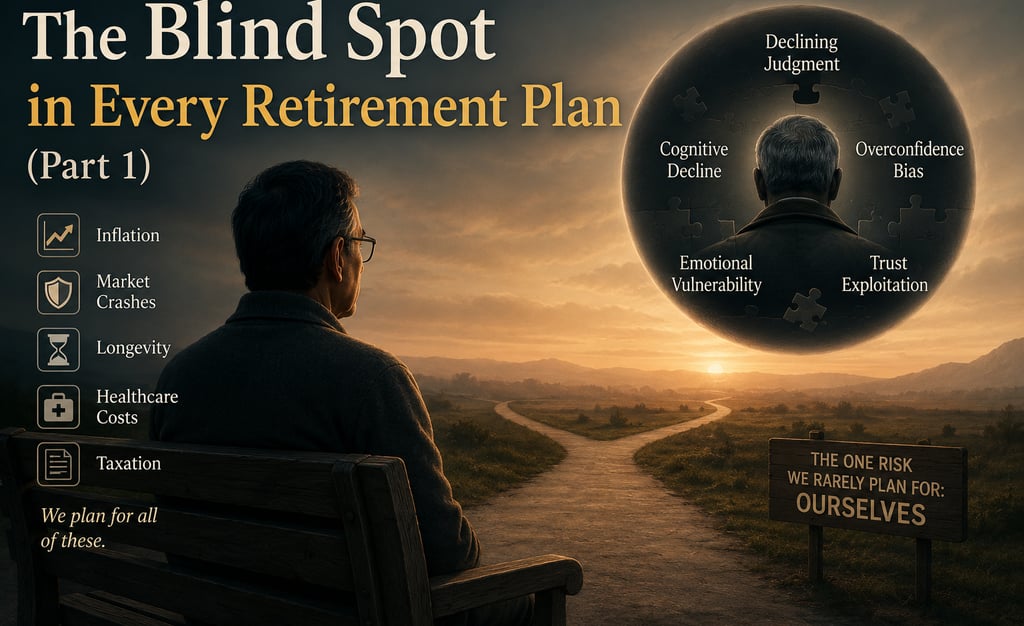
We plan for inflation, longevity, and market crashes. We rarely plan for our own decline.
FINANCEBLOG

For the last five years, I have spent a significant amount of time thinking about retirement planning. Not just the numbers, but the assumptions underneath them.
Like most DIY investors, I started with the obvious questions. How much corpus would we need? What withdrawal rate is safe? How do I stress-test the plan against inflation, sequence risk, and taxation? I built spreadsheets, ran scenarios, and used conservative assumptions because markets owe nobody a guaranteed return.
Most of the real struggle, I discovered, had little to do with finding the right fund or the perfect asset allocation. It was behavioural. Learning not to react to every market movement. Resisting the urge to constantly optimise. Accepting that good decisions often feel uncomfortable in the short term.
But somewhere in this process, a thought occurred to me that no spreadsheet could answer.
I had forgotten to account for myself.
Not the current version of me, but a future version that may not think, analyse, or make decisions the way I do today. Every retirement calculation I had built quietly assumed continuity. The person constructing the plan at forty-five would remain essentially the same person managing it at seventy-five. I had planned for markets to change, inflation to surprise, and tax rules to shift. I had not planned for the possibility that the decision-maker himself might change in ways no Excel model can capture.
That thought stayed with me far longer than any debate about safe withdrawal rates ever did.
What the research actually says
Growing older always felt like a distant problem. Something to think about later. Then I came across research on ageing and financial decision-making, and it unsettled me in a way that market crashes never have.
Several studies show that financial literacy declines steadily after the age of sixty, by roughly one percentage point every year. What struck me more than the decline itself was what does not decline alongside it. Confidence. People become measurably worse at financial decision-making while continuing to feel just as capable as before.
That gap between competence and confidence is where the real risk lives.
Researchers have also found that missed bill payments and unusual financial transactions can appear several years before a formal diagnosis of cognitive impairment. In some cases, the financial system notices the early signs before medicine does. And when I started reading about elder financial abuse in the Indian context, the picture became even less comfortable. The perpetrators are frequently not strangers running phone scams. They are often people already known to the family, relatives, caregivers, or individuals who have slowly built trust over years.
The most unsettling part is not the decline itself. It is that declining ability often arrives quietly while confidence stays intact. We may not realise anything has changed. And that, perhaps, is precisely what makes it dangerous.
The retirement state nobody talks about
Most retirement planning assumes two states.
You are either alive and capable, managing your wealth with the same judgement you always had. Or you are gone, and wills, nominations, and succession plans take over.
There is a third state that receives almost no attention in any retirement planning conversation I have encountered. Being alive, holding substantial assets, and no longer fully capable of managing them.
This state is harder than death in one specific way. Death is legally clear. Nominations matter. Wills matter. Assets transfer according to documented wishes. But when the person is still alive, ownership and legal authority remain with them, even as the ability to exercise that authority well quietly erodes.
The risks here are not dramatic. They are mundane, and that is exactly why they are so easy to ignore. A health insurance premium forgotten. A large withdrawal that nobody questions because the account holder authorised it. A persuasive family member recommending a complicated product. A panic-driven decision during a market correction that undoes decades of discipline. A portfolio gradually becoming unmanageable because it was designed for the cognitive capacity of a fifty-year-old, not a seventy-eight-year-old.
None of this requires severe impairment. It requires only a modest, gradual decline in judgement combined with high confidence and substantial financial resources.
Why the obvious solutions only solve part of the problem
The instinctive answers sound reassuring. Write a will. Keep nominees updated. Simplify the portfolio. Trust your children.
But each of these solves only a portion of the actual problem.
A will addresses death, not diminished judgement. Simplifying a portfolio reduces complexity but does not eliminate decisions. Someone still has to decide when to withdraw, when to rebalance, and how to respond to circumstances that change. And trusting family members completely carries its own risks, not because children are necessarily selfish, but because dependence changes relationships in ways nobody plans for.
We all remember Baghban because it touched something real. Not because every family looks like that, but because the film named a vulnerability most Indian families feel but rarely discuss openly. Financial dependence and emotional dependence are two different things, and conflating them in retirement planning can leave a person exposed in ways they did not anticipate.
Perhaps the most difficult part of this problem is what researchers call the handover challenge. The person experiencing cognitive decline is often the last to recognise it. Self-assessment becomes unreliable at exactly the stage when accurate self-assessment matters most. You cannot expect someone to voluntarily step back from financial decision-making when they genuinely believe they are functioning as well as they ever did.
I have seen glimpses of this in older relatives. Nothing dramatic, not dementia, not any headline event. Just growing stubbornness in financial matters, increasing confidence in opinions that seemed to have weakened foundations, small mistakes that everyone around them noticed before they did. The difficulty is that there is no precise moment when responsibility should transfer. No annual check-up that flags it. No dashboard warning. And by the time everyone agrees that something has shifted, time has already passed.
The blind spot
For decades, retirement planning has focused on protecting our future selves from external risks. Inflation, market crashes, longevity, healthcare costs, taxation, sequence risk. These all have frameworks, calculators, and rules of thumb attached to them.
But there is a question that sits outside all of those frameworks.
What if the greatest long-term risk to a retirement corpus is not a market event, but the gradual transformation of the person responsible for managing it?
That question has no clean answer, which is probably why it rarely appears in retirement planning conversations. But ignoring it does not make it less real. It only means the plan has a blind spot where one of its most important assumptions lives unchallenged.
The person who spent thirty years building the corpus may still be around. But the person who knew how to protect it may no longer be.
True financial independence may not just be about building enough money. It may also be about building the systems, structures, and relationships that can protect us from a version of ourselves we have not yet met.
In Part 2, I will explore what some of those structures might actually look like in practice, for an Indian family managing its own finances without professional oversight.
sneharege.com
Sneha Rege writes about money, behaviour, and the decisions in between.
For Indian salaried professionals who are building a financial life without a manual.
for COLLABORATIONS AND consultations.
For Sharing Feedback
contact@sneharege.com
+917083952477
© 2026. All rights reserved.