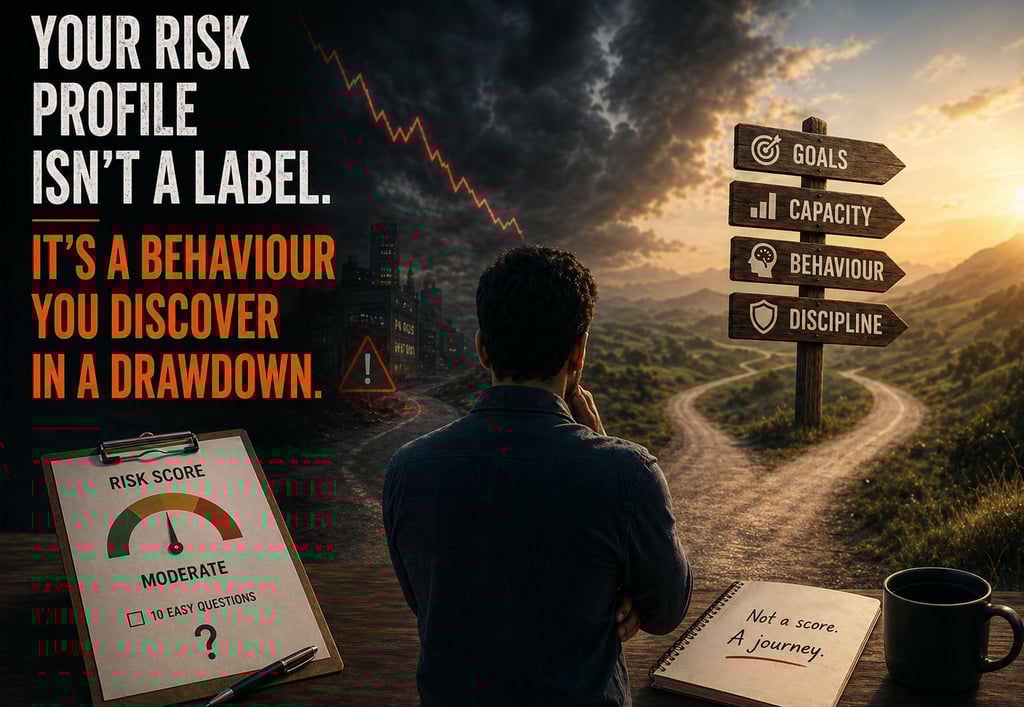
Your Risk Profile Isn't a Label. It's a Behaviour You Discover in a Drawdown.
What risk profiling tools don't understand about real investor behaviour.
FINANCEBLOG

I recently tested several risk profilers available online to Indian DIY investors. Most of them, I realised, are built to sell rather than to help.
I didn't set out to write this. I was just trying to find a decent risk profiling tool for myself as part of my research for my NISM Retirement Advisor preparation. The plan was simple: use a few well-known options, see what each one asked, and figure out which one actually tried to understand me as an investor.
What I found instead was a tour through poor design, lazy questions, and tools that quietly merge "knowing your risk" with "buying our products." This is what stood out, and why I think the average DIY investor should be sceptical of most free risk profilers floating around the Indian internet.
A risk profiler should not be a product funnel
The first thing you notice when you sit down with these tools is how short they are. Ten questions on average, sometimes nine. Almost none of them ask about the things that actually shape your risk capacity, like your savings rate, your debt, your dependents, your job stability, your health, or your existing portfolio.
ICICI Prudential's tool asked me ten general questions, took my age and gender, and tagged me "Moderate." That was it. No question about an emergency fund. No question about financial commitments. No question about whether I had loans running.
One of the questions was: "To what extent would you expose your investments to risk to earn higher returns? 10%, 20%, 30%, 50%?"
If I already knew the answer to that, I would not be looking for a risk profiling tool in the first place. The whole point of profiling is to help me discover that number, not to ask me to declare it upfront.
Nippon's confident questionnaire
Nippon's tool started better, but lost me on this question: if your portfolio falls 20% a few months after investing, what would you do?
The five options ranged from "panic and exit" to "buy more confidently." None of them said, "Review whether the fundamentals of the investment have changed." None of them allowed for "check if the fund manager is still doing what they claimed to do."
Investing is not just an emotional reflex test. A serious response to a drawdown is to check whether your original thesis still holds. That option simply did not exist.
After nine such questions, I was tagged "Moderate" again, given a 45/45/10 split across equity, fixed income and gold, and shown five Nippon funds across those categories. The risk profile and the product pitch were stitched together so seamlessly that you would only notice if you were paying attention.
This is the core problem with AMC-hosted profilers. A tool that is structurally incapable of recommending against its own products is not a suitability assessment. It is a distribution channel with a questionnaire attached.
What the others looked like
Mirae Asset began with a good question, asking about my savings rate. I was genuinely interested. But I could not actually select the option. Their form was broken, and the quiz stopped responding after the fourth question. A multi-crore AMC could not get the basics of its own tool working.
Finology asked me to log in, then asked me to upgrade to a paid plan to even take the test. No preview, no trailer of what was inside, just a paywall.
DSP gave me ten questions, of which only one was genuinely useful: what percentage of your salary goes toward EMI. The rest were standard. I was told I scored "65%." There was no explanation of what that number meant or what to do with it.
Across these tools, the pattern was consistent. A handful of generic questions, a quick label, and a soft nudge toward whatever the AMC happened to be selling.
The professional and overseas options
Out of curiosity, I looked at Morningstar's risk profiling system. It turned out to be Morningstar FinaMetrica, an adviser-only tool reportedly licensed at upwards of 700 USD a year for professionals. Not built for DIY investors, and not easily accessible in any case. Even a serious tool like this only measures risk tolerance; capacity and required return are separate exercises that someone has to do on top.
Vanguard's questionnaire was free and clean, but it was built for a US investor and used examples from American market history. One question asked how I would have reacted to bonds losing 4% in September–October 2008. With the benefit of hindsight, anyone can answer that question correctly. Asking people to imagine a past crisis whose outcome they already know does not test anything real.
Another question used a chart of the best and worst one-year returns on three hypothetical portfolios. As someone studying actively for the SEBI RIA path, even I had to read it twice. For a beginner, it would be impenetrable.
I also tried a tool that AI search results kept recommending: mfd.webclass.in. The first question asked how I would describe my tolerance for losses. The options were Very Low, Low, Moderate, and High. A generic question with generic answers. The next one asked what percentage of my assets I was comfortable allocating to equity. Again, if I knew that, I would not need the tool.
And then, before showing me any result, it asked for my PAN. To tell me my risk profile.
I closed the tab.
Why does all of this matter
It is easy to dismiss risk profiling as a formality, a box to tick before you start "actual investing." That mindset is part of the problem.
Your risk profile is not a label. It is the quiet answer to a question you can only really test in a downturn: would I sit on a 30% drawdown across a portfolio worth several years of my savings, without acting on impulse? Most of us think we know the answer. Very few actually do.
A ten-click quiz cannot tell you this. Neither your YouTube watch history nor your Instagram saves on small-cap funds with the lowest risk ratios. Reading about volatility is not the same as living through it. Knowing the theory of drawdowns is not the same as watching a chunk of your net worth disappear on a Tuesday afternoon.
The tools available today, especially in India, do not bridge this gap. They paper over it.
What a DIY investor can do instead?
If you are starting out, treat the AMC-hosted profiler as what it is — a soft sales funnel. The score has limited meaning. Use it to start a conversation with yourself, not to settle one.
Spend more time on the questions these tools do not ask. What are your actual financial goals? How stable is your income? How many dependents do you have, and what do they rely on you for? What are your fixed monthly commitments? How much liquidity do you keep aside? How far away is your retirement? How have you behaved during past corrections, however small? What would genuinely change in your life if your equity portfolio were halved tomorrow?
The list is long, and it is non-negotiable if you want a real answer. None of these are questions a fund house will ever ask in a ten-click quiz.
There is also a dimension most tools ignore entirely: your risk appetite is not fixed. As your portfolio grows, the rupee value of every drawdown grows with it. A 30% fall on five lakh feels very different from a 30% fall on fifty lakh, and different again at five crore. The percentage is identical; the experience is not. You have to keep asking yourself whether you still have the stomach for it as the absolute numbers change. Life events shift this, too. A new home loan, a child, an ageing parent, a job change — any of these can quietly redraw your capacity for risk without you noticing.
If you have never lived through a real downturn, accept that humility upfront. Start smaller than you think you should. Let your behaviour during the next correction inform your real risk profile, not a questionnaire built by a fund house that needs you to keep buying.
And if there is genuine doubt about how to think through all this, the cleanest path is to work with a fee-based planner whose only job is to provide conflict-free advice. A proper engagement involves discovery conversations, not a single sitting, with periodic reviews to check whether your circumstances or temperament have shifted. Risk appetite is not a setting you configure once. It is something you meet again at every new portfolio size, every life event, every market cycle.
Risk profiling, done seriously, is uncomfortable. That is exactly why most free tools avoid it.
This is not advice. Just a way to think more carefully about a step most investors rush through.
sneharege.com
Sneha Rege writes about money, behaviour, and the decisions in between.
For Indian salaried professionals who are building a financial life without a manual.
for COLLABORATIONS AND consultations.
For Sharing Feedback
contact@sneharege.com
+917083952477
© 2026. All rights reserved.