A Life That Works on Paper
A Mother's Day Special
BLOGSTORIES
A Mother's Day Special
A Life That Works on Paper. But quietly breaks the person living it...
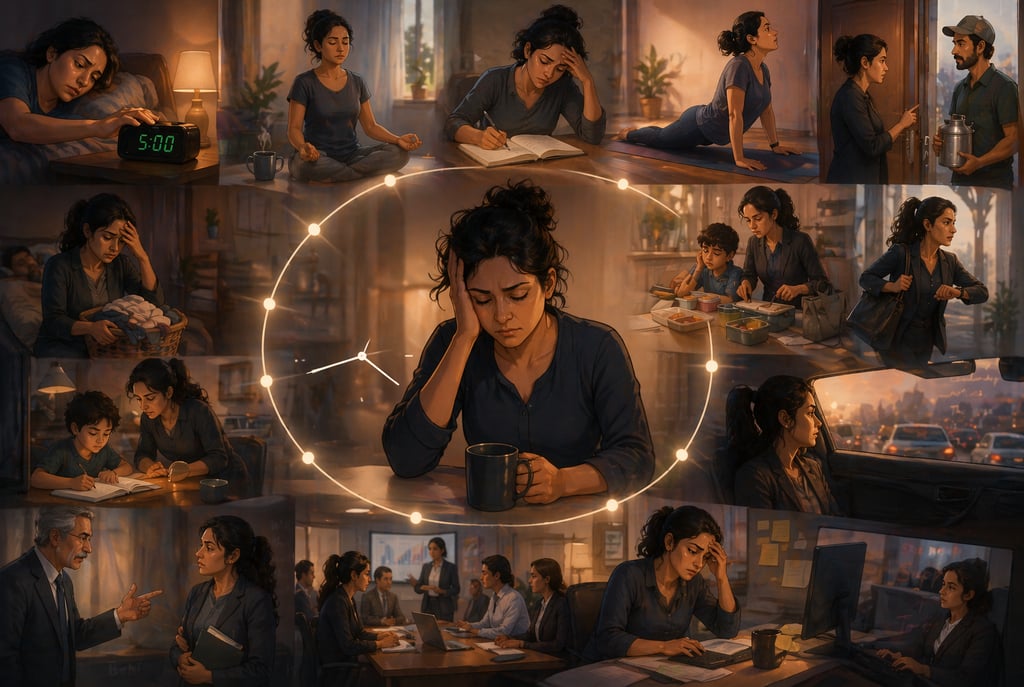
She wakes up at 5:00 a.m.
For a moment, she considers snoozing. Just a few more minutes of sleep.
But she doesn’t.
Because if she does, the cook might leave. And that one small decision will ripple into a day she cannot afford.
So she gets up. Not with energy, but with compulsion.
She makes herself a black coffee and sits down to meditate.
But her mind is already moving ahead of her.
Groceries to buy. Meals to plan. Things to tell the cook.
The clock ticks loudly in the background. A bird chirps somewhere. Machines hum in the distance.
Meditation becomes planning.
She opens her journal.
What comes out is not clarity. It is frustration.
Colleagues who drain her. A boss who wants more ownership. Friends who feel distant. A child who doesn’t listen the way they used to. A partner who is still asleep.
No villains. Just a quiet sense of being alone in it all.
She starts her workout. A few Surya Namaskars to reclaim some control over her body.
The doorbell rings.
Milkman. Then the cook. Late, as usual.
Instructions follow. Adjustments are made.
She returns to her mat, but she doesn’t remember where she left off.
Left foot or right?
It doesn’t matter anymore.
By 8:30 a.m., she has already lived half a day.
Tiffin's are packed. The child is woken up after multiple attempts. She rushes through her own routine.
There is no pause. No space.
Just movement.
She skips makeup and rushes out.
Because a few minutes here or there can mean an extra hour in traffic.
The office feels familiar.
Meetings about work that was assigned just yesterday. Messages marked “ASAP.” A constant need to appear busy.
Another note from the boss—step up, take ownership.
She wonders, quietly, what exactly she is not already carrying.
At 5:00 p.m., she watches the clock.
Not because work is over. But leaving on time is the difference between a manageable evening and complete exhaustion.
Around her, younger colleagues stay back. Leadership notices.
She feels the gaze. Not spoken. But understood.
At home, it continues.
Homework reminders. Repeated instructions. Rising frustration.
And somewhere in the background, a quiet, unsettling thought:
Will any of this even matter in the future my child is growing into?
By night, she already knows.
Tomorrow will be the same.
She is not struggling financially.
She is not alone.
She is not “failing” in any visible way.
And yet, she feels broken.
This is the part no one talks about.
The problems of the “privileged” are dismissed before they are understood.
Because someone always has it worse.
So she doesn’t complain.
She just continues.
But there is something real happening here.
Something invisible.
It is nearly impossible to work 40+ hours a week, manage a home, raise a child, stay emotionally present, and still take care of yourself in every way that is expected.
Yet that is exactly what is silently demanded.
And this is where the language of “balance” starts to feel dishonest.
Because this is not about poor time management.
It is about too many roles being carried by one person for too long.
Society expects her to do it all.
To be a nurturing mother. A supportive partner. A reliable professional. A present friend.
And somehow still be calm, centred, and put together.
But how do you pour into yourself when you are constantly being emptied out?
She wakes up tired.
She goes to bed exhausted.
And she doesn’t ask for help.
Not because she doesn’t need it. But because when she does, it is often met with guilt, judgment, or promises that don’t last.
So she keeps going.
Because she has to.
And if you have never lived a day like this, it is easy to give advice.
“Take better care of yourself.”
“Wake up earlier.”
“Prioritize your time.”
But none of that addresses the real issue.
She is not failing at self-care.
She is carrying too much.
What she needs is not another system.
Not another routine.
Not another reminder to optimize herself.
She needs support that is real.
She needs fewer things to hold.
She needs space.
Most of all, she needs to be seen.
Because sometimes, the hardest lives are not the ones that are visibly broken.
They are the ones that look perfectly fine from the outside, but are quietly exhausting the person living them.
sneharege.com
Sneha Rege writes about money, behaviour, and the decisions in between.
For Indian salaried professionals who are building a financial life without a manual.
for COLLABORATIONS AND consultations.
For Sharing Feedback
contact@sneharege.com
+917083952477
© 2026. All rights reserved.