How Much Is Enough?
How defining three simple numbers changed the way I think about survival, comfort, and freedom.
A video casually mentioned something that stayed with me.
“If you need ₹50,000 a month for essentials, around ₹1.7 crore could be sufficient.”
It wasn’t dramatic. It wasn’t selling financial freedom at 40.
It was just math.
And strangely, I felt relief.
₹1.7 crore is not a small number. But for the first time, “enough” didn’t feel abstract. It felt measurable.
For years, I’ve believed something quietly but firmly:
We don’t feel anxious because we don’t have enough.
We feel anxious because we don’t know what “enough” is.
That video didn’t make me rich.
It made me clearer.
The Three Numbers I Keep Coming Back To
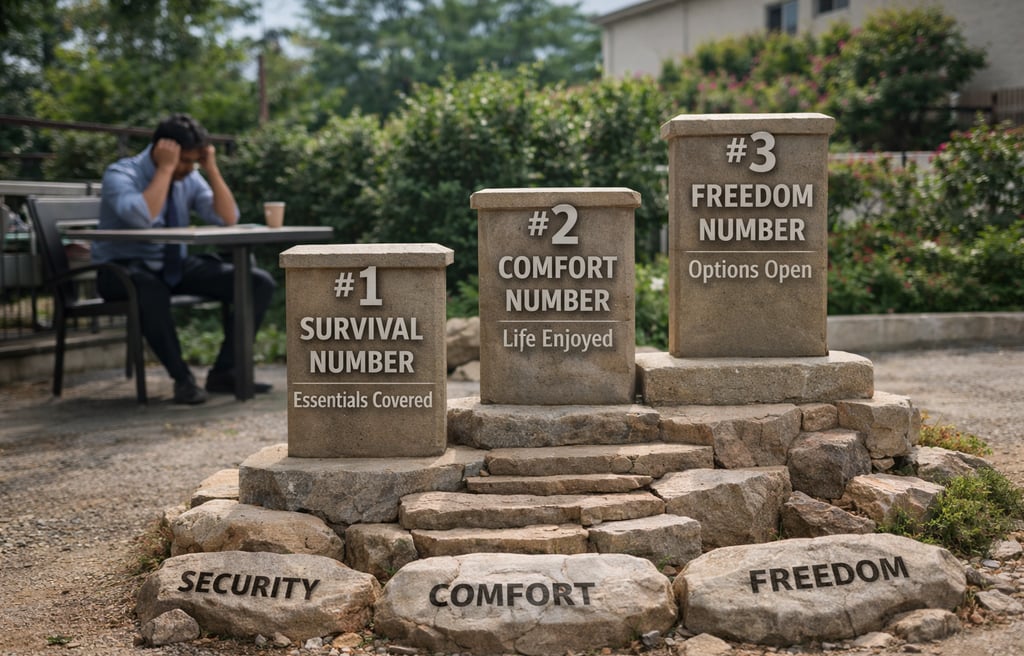
Over time, I’ve realised I think about money in three layers. Not targets. Not goals to impress anyone. Just anchors.
1. Survival number
2. Comfort number
3. Conservative / freedom number
These three numbers changed how I relate to money.
Not how much I earn.
Not what I invest in.
But how I behave.
And behaviour is everything.
A Story I Didn’t Expect to Write
This part is harder to admit.
Recently, both equity and commodity prices have been falling. On paper, it’s just a market fluctuation. Temporary. Cyclical.
But the loss didn’t feel isolated.
The environment feels uncertain. I woke up already exhausted. Some days it genuinely feels like I’m one breakdown away from collapsing.
What surprises me is this:
I used to tolerate this better.
Earlier, I would rationalise. Adjust. Endure. Convince and tell myself, “This is how it is.” or, “Others have it worse”.
Now I can’t.
And after sitting with that discomfort, I realised something uncomfortable but powerful:
My tolerance has dropped because my fear has dropped.
I now have what I call survival money.
Not “retire tomorrow” money.
Not “luxury lifestyle” money.
But enough to survive.
And once you know you can survive without something, your tolerance for nonsense drops sharply.
That is not rebellion.
That is psychological safety.
1. The Survival Number, The Number That Changes Your Spine
The survival number is simple:
If income stopped, what corpus would generate enough to cover only essentials?
Rent or EMI. Groceries. Utilities. Insurance. Basic healthcare.
No upgrades. No indulgences. Just dignity.
When I started preparing for the NISM-Series-XVII: Retirement Adviser Certification Examination, one idea stood out to me deeply:
Retirement planning does not begin with returns.
It begins with estimating expenses realistically.
You build upward from need.
Not downward from fantasy.
That framework reinforced something I had intuitively believed, clarity about essentials is more powerful than chasing aggressive growth.
When you define your survival number, fear becomes finite.
Markets may fall. Jobs may become unstable. People may disappoint you.
But you won’t collapse.
And that knowledge subtly changes how you walk into rooms.
2. The Comfort Number, The Number That Softens Your Life
Comfort is different from survival.
Comfort includes:
• Occasional travel
• Eating out without calculating guilt
• Supporting family
• Small lifestyle upgrades
• Margin in your monthly life
This is the number at which money stops being a constant background calculation.
You don’t check your portfolio compulsively.
You don’t panic at every correction.
You don’t feel threatened by temporary uncertainty.
If survival gives you a spine, comfort gives you breathing space.
Many people skip this layer. They jump from “I must survive” to “I must be financially free.”
But comfort is where psychological wealth begins.
As Morgan Housel writes in The Psychology of Money:
“The highest form of wealth is the ability to wake up every morning and say, ‘I can do whatever I want today.’”
That ability doesn’t start at extreme wealth.
It starts when fear reduces.
And fear reduces when numbers are defined.
3. The Conservative / Freedom Number, The Number That Buys Optionality
The freedom number is the one we romanticise.
The ability to:
• Leave a toxic workplace
• Start something of your own
• Work because you choose to
But here’s what I’ve realised:
If you chase this number without defining survival and comfort first, it never feels enough.
Because insecurity expands infinitely.
Clarity contains it.
Freedom is not about abundance.
It is about optionality.
And optionality begins the moment you know you can survive.
The Behavioural Shift No One Talks About
We think money changes lifestyle.
It does.
But more importantly, it changes tolerance.
When you don’t have survival money, you tolerate:
• Disrespect
• Toxic systems
• Exhaustion
• Unfairness
Because you feel trapped.
When you have survival money, something shifts internally.
You still feel fear.
You still feel uncertainty.
But you no longer feel cornered.
That difference is everything.
The silver loss this month is uncomfortable. But it isn’t catastrophic.
The work environment is draining. But it no longer feels inescapable.
Earlier, both together would have spiraled me into panic.
Now they feel like situations.
And situations can be handled.
That shift did not come from doubling my corpus.
It came from defining what I truly need to survive.
The Realisation
Money problems are rarely arithmetic problems.
They are interpretation problems.
Two people can have the same ₹1.7 crore.
One feels secure.
The other feels behind.
The difference?
One knows what the number means.
The other is still comparing it.
Comparison fuels insecurity.
Definition reduces it.
A Quiet Exercise
Instead of asking:
“How much should I accumulate?”
Ask:
What is my survival number?
What is my comfort number?
What is my conservative / freedom number?
Write them down.
Not to impress anyone.
Not to compete.
But to calm your own nervous system.
Because clarity is not about wealth.
It is about removing ambiguity.
Closing Thought
I used to think financial freedom meant never worrying again.
Now I think it means something smaller and more powerful:
Knowing you can survive without what is harming you.
Once that knowledge enters your system, your standards rise.
Your tolerance drops.
And you start building a life not out of fear — but out of choice.
And perhaps that is what “enough” was always meant to do.
sneharege.com
Sneha Rege writes about money, behaviour, and the decisions in between.
For Indian salaried professionals who are building a financial life without a manual.
for COLLABORATIONS AND consultations.
For Sharing Feedback
contact@sneharege.com
+917083952477
© 2026. All rights reserved.